
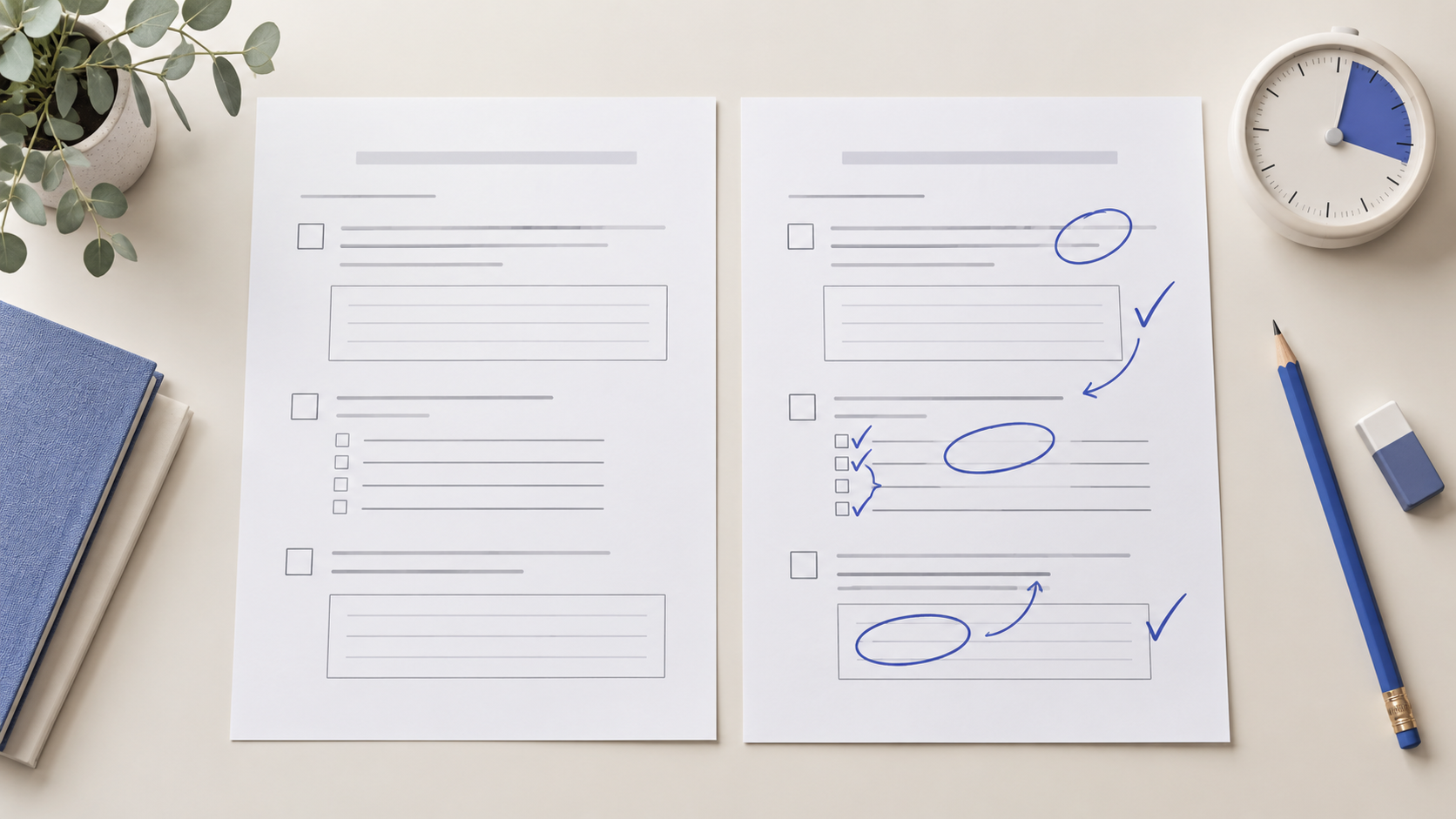
How to Use Lebanese Past Papers and Marking Schemes
Past papers can show you how a question is written, how much work it requires and which parts of your method need attention. Their value comes from the full cycle: choose, attempt, check, correct and retry.
Start with the Shadykone Lebanese official-exam archive, which links to original CRDP documents and identifies available marking schemes. The downloadable collection currently covers selected papers from 2022, 2023 and 2024, with coverage varying by certificate, branch and session. Status notes for other years are not additional paper downloads.
Choose the exact paper you need
Before answering anything, check the certificate, branch, subject, language, year and session on the paper itself. A Terminale GS paper and a Terminale SE paper are not interchangeable merely because both say mathematics.
Also check the current requirements with your teacher and official notices. Older papers may contain topics, choices or instructions that do not apply to your present exam. If your teacher selects only part of an older paper, label it as selected-topic practice rather than treating its score as a full mock result.
CRDP publishes an official paper and correction archive. Some linked PDFs combine the exam and correction in one file. A correction can begin after the question pages, and its printed page numbering may restart.
Separate learning practice from a timed check
For learning practice, choose a short section and allow yourself time to think. Write down where you become stuck. If you need a worked example, use it, but mark the question as assisted.
For a timed check, prepare a suitable unseen paper or section, follow its instructions and use only permitted resources. Decide the time limit beforehand. Stop when it ends and leave unfinished work visible. You are collecting evidence about pace as well as knowledge.
Do not compare an assisted, untimed score directly with an independent timed score. Write the conditions next to each result so that you can interpret progress fairly.
Attempt the question before opening the correction
Keep the answer pages out of view. Show your setup, method, calculations and conclusion. If you cannot finish, record the point where your reasoning stopped rather than leaving an unexplained blank.
Roediger and Karpicke’s research found that recalling studied material improved later retention in their experiments compared with repeated study alone. Their study used prose passages; it supports active recall as a learning principle, not a promise about your marks in a Lebanese exam.
For problem solving, use the attempt to expose decisions: Why this equation? Why this theorem? What evidence supports this conclusion? Those questions make the correction more useful.
Read the marking scheme one decision at a time
Compare your work with the relevant question number and subpart. Check more than the final number. Look for the required explanation, intermediate calculation, unit, diagram or conclusion.
Do not invent partial-credit rules when a correction is unclear. If your valid-looking method differs from the published approach, ask a teacher to judge it. Preserve any label such as “draft” or “proposed correction”; publication on an official site does not remove the source’s own qualification.
In some papers, the visible scales in the question and correction can differ. For example, the 2024 GS mathematics PDF labels its correction as proposed and shows different question-point scales across the exam and correction sections. Do not silently combine those scales into a self-awarded official grade. Use the document to inspect the method and ask your teacher how to interpret the scoring.
Turn each important error into a repair task
Use this error-log template:
- Paper and question: identify the exact item.
- What happened: describe the first wrong decision.
- Cause: concept, method choice, algebra, reading, units or time.
- Correction: explain the right decision in one sentence.
- Retry: choose a similar unseen question and a later date.
Example: “Motion question | used 72 as metres per second | unit conversion | convert 72 km/h to 20 m/s before substituting | retry a different speed-conversion problem on Friday.”
“Be more careful” is too vague to change your next attempt. “Write the units beside every given value before selecting the equation” is an action you can check.
Retry without copying the solution
After correcting the method, close the answer and rebuild your solution. Then use a similar question later with different numbers or wording. If you can only reproduce the original answer, you have not yet shown that you can choose the method independently.
Track questions as independent, assisted or not yet secure. Keep a short list of recurring errors and bring the most persistent one to a teacher with both your attempt and the correction.
Your next practice session
Choose one relevant question set, keep the answers hidden, and leave time to mark and retry. If the paper exposes a foundation gap, use the free lesson library before attempting another full paper. A smaller set with a complete correction cycle is often a more useful next step than an additional unchecked exam.