
How to Build a Lebanese Official Exam Revision Plan
A useful revision plan tells you what to practise next, how to check it and when to return to it. If you are preparing for a Lebanese official exam, start with your confirmed exam requirements and an honest picture of your current skills. Then build a week you can actually complete.
This guide works for Brevet and Terminale preparation, with topics adapted to your certificate and branch. It is a study method, not an official syllabus or exam announcement. Check current arrangements with your school and MEHE; use the relevant dated documents from CRDP. An older paper does not establish next year’s requirements.
1. Make a topic list before making a timetable
Collect your teacher’s current topic list, course notes and a few suitable questions. Write one row for each skill you need to demonstrate. “Mathematics” is too broad. “Solve a linear equation with brackets” is specific enough to practise and check.
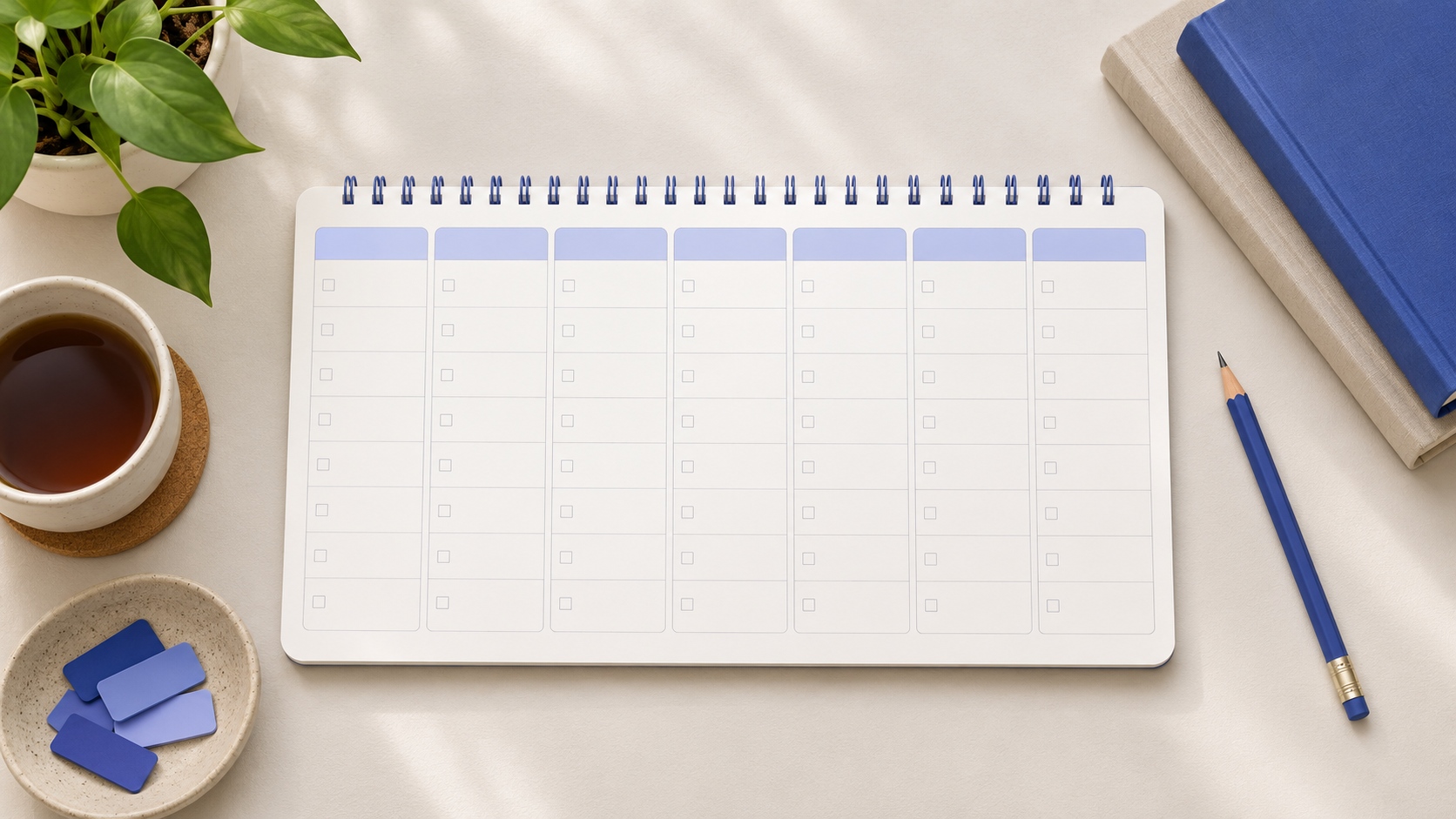
Use these four columns on paper:
- Topic or skill
- Evidence from a recent attempt
- Next practice task
- Date to check again
For example: “Linear equations | expanded a negative bracket incorrectly | solve four bracket questions and explain each sign | Thursday.” That row gives you an action. “Bad at algebra” does not tell you where to start.
If you need a general starting suggestion, try Find Your Starting Point. Its short skill checks are a learning guide, not a validated placement exam or a prediction of an official-exam result.
2. Test a small sample without your notes
Choose a few questions across the required topics. Attempt them before checking examples. Record what you could do independently, where you needed a prompt and where you could not begin. Keep these categories separate: recognising a solution after reading it feels different from producing one yourself.
Prioritise a weak prerequisite that blocks several topics. For example, repairing fraction arithmetic may help with equations, ratios and physics calculations. Give stronger topics shorter review slots rather than dropping them entirely.
3. Give each session a visible result
Replace “revise physics for an hour” with “draw three force diagrams, solve two questions and correct one earlier error.” Start with a manageable session length and adjust it to your attention, schoolwork and responsibilities.
A possible 45-minute session is:
- Five minutes: recall the main idea or redo one earlier question.
- Twenty-five minutes: work through a small question set.
- Ten minutes: check the method and correct errors.
- Five minutes: choose the next task and its review date.
These timings are a practical example, not a scientifically required ratio. If one question needs longer, finish its correction before adding more work.
4. Spread repeat attempts across the week
After learning a method, revisit it on later days. Research by Cepeda and colleagues found that spacing study occasions affected later retention, with useful spacing depending on the time until the final test. There is no single perfect gap for every subject and learner.
Use a simple first version: practise on Monday, try a fresh question on Thursday and include the skill in a mixed set the following week. Shorten the gap if you cannot get started; lengthen it gradually when you can solve and explain reliably.
A realistic one-week example
- Monday: diagnose two maths topics; correct the weakest prerequisite.
- Tuesday: physics topic practice; revisit one earlier maths error.
- Wednesday: revise another required subject; write answers from memory before checking.
- Thursday: retry Monday’s skill using different numbers; practise a second physics question type.
- Friday: attempt a selected past-paper section under suitable timed conditions.
- Saturday: mark the attempt, repair two important gaps and plan next week.
- Sunday: leave space for rest or a short catch-up, according to your workload.
This is a structure to adapt across your subjects, not a complete timetable. Add time where the required workload demands it. Leave some unscheduled space so that a difficult question or a missed session does not collapse the whole plan.
5. Add past papers after checking their relevance
Use the Lebanese official-exam archive to find available papers by year, certificate, branch, language and session. Coverage varies. Choose questions that match your current requirements, and keep at least one suitable unseen set for a later independent check.
Early on, practise selected questions slowly. Later, try longer sections with the stated instructions. Mark the attempt and spend time on the cause of each error. Completing a paper without reviewing it leaves valuable information unused.
Review the plan using evidence
At the end of the week, answer three questions: Which skill can I now perform without help? Which error repeated? What is the smallest useful task for next week? Count corrected and successfully retried skills alongside marks.
Start today with one topic row and one question. For a lesson with explained practice, visit the free lessons and revision resources. A good plan becomes clearer as your work gives you evidence.